

Matriarchs of Morocco: The Legacy of Amazigh Jewelry
By: Ifri (Yassmine Khiri)
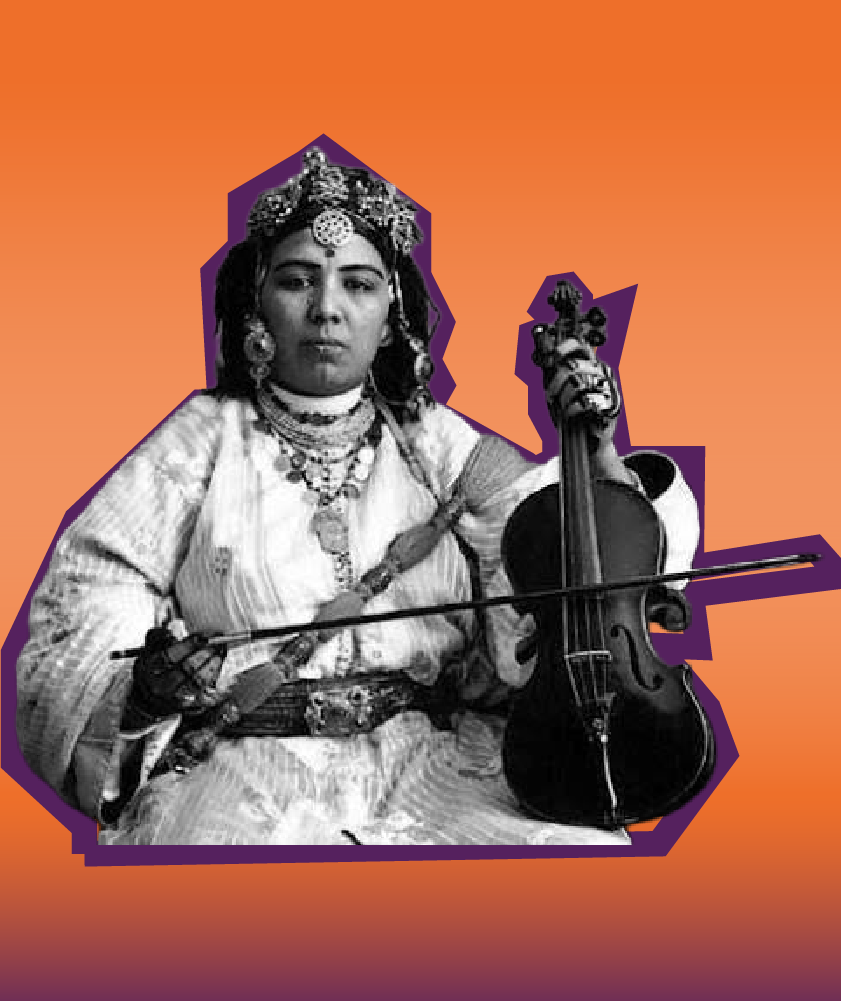
Amazigh Jewelry has been worn by Amazigh women since the dawn of time. The first ever recorded drawing of a Tizerzai fibula is actually rock art dating back 5000 years ago. In the case of Tighremt n'Ouazdidene site, the triangular fibulas are very clearly defined portraying tribal symbols and linked by a chainlet. There is even a single fibula with a buckle engraved on the rock formation (Rodrigue, 2014).
Historically Amazigh jewelry has always been inspired from nature and has mimicked patterns by multiple mediums such as etching, molding and enamelling silver. Amazigh artisans alongside their masterpieces have been carrying the craftsmanship of centuries of silverwork. Amazigh women have historically been responsible for preserving the memory of thousands of ancestors, and the cultural heritage. Every single pattern, every single material, and every single color that is enameled onto silver has meaning, function, and symbolism.
Tizerzai Fibula
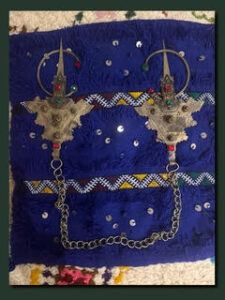
The Tizerzai Fibula is a representation of the wombs of women, but also of the goddess of fertility, war, and protection, Tanit. The three points of this triangular shaped adornment are associated with birth, life, and death emulating the cycle of life. The Tizerzai comes crafted in many different forms and shapes, sometimes varying depending on tribe and region. Its size depends on the societal importance and status of the woman wearing it. Usually the heavier, larger, and more intricate the fibula, the higher in status the woman is.
Fibula structure was very important; so was the way it was worn. It was displayed as a code and a form of communication. Women who were single wore one fibula on their right side by their right shoulder. Another unwritten rule was that a single woman who wore one fibula on their heart side by their left shoulder, was subtly signaling that their heart is already taken meaning they are engaged. Amazigh women who wore two fibulas without a chain were divorced and the ones who wore two fibulas with a chain were married. This code showed the romantic and marital status of these women therefore avoiding being approached by unwanted suitors. These canons vary from tribe to tribe and region to region. However, the symbolism of a woman's marital status was also displayed via henna ornaments, tribal tattoos, veils, belts styling, and even hairstyles.
The Dove Foot And The Dove Tail
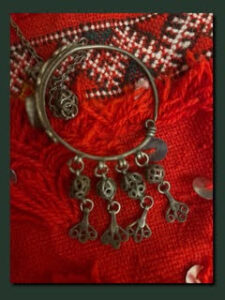
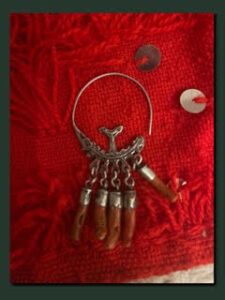
The dove foot and the dove tail (Tiferfrin) are an Amazigh ornament, often added to necklaces and earrings. In Amazigh culture the dove is a sign of beauty, fertility, femininity and good luck (Baraka). Some examples of cultural sayings that denote the association of the dove with beauty such as: “This woman is as beautiful as a dove.” Or “She is as graceful as a dove.” The dove foot comes in different shapes and forms, even made as a filigree piece, an etched symbol, a niello engraving, or molded as part of an earring (Chouchna or Dawooh). These charms are very abundant in Eastern Sahara tribal jewelry and other arid areas; the dove foot is associated with fertility, therefore water. Amazigh tribes from arid areas biggest challenge is usually facing drought, so the dove foot is an essential talisman to wear when manifesting water. Another interesting fact about the dove in Amazigh culture is it’s one of goddess' Tanit sacred animals, along with the horse and the lion. Even when it comes to beauty, Amazigh women are inspired by nature and aligned with natural elements honoring and cherishing natural traits, by choosing animals such as doves and gazelles to emulate and represent beauty and grace. Alternatively to western beauty standards that are deeply rooted in superficiality and manufactured beauty standards.
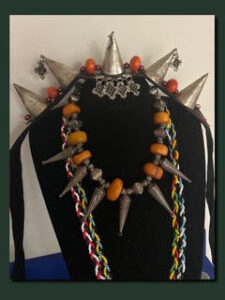
The Isni Headdress
Continuing with historical items such as the Isni Headdress, from the Ait Baamrane tribe, a beautiful headdress with silver cones separated by amber and carnelian beads.These elaborate head pieces had been historically used to transport gunpowder in secret. A hollowed out inside design of the silver cones allowed women to hide gunpowder and carry it from one area to another. This covert tactic helped to supply the resistance fighting against the French and the Spanish during colonialism. Weapons transport was forbidden and punished heavily, during the colonial era, however the colonizers due their misogynistic beliefs, did not see Moroccan women as a part of the resistance, therefore overlooking their important contribution to combatting the enemy. Both beautiful and life-saving, the Isni headdress was inspired by the rays of sunshine and astral projections from the stars and other celestial bodies.
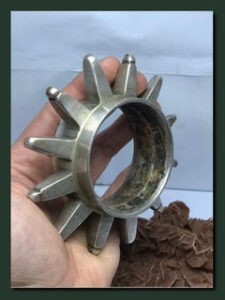
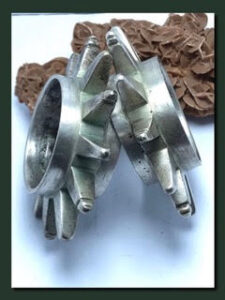
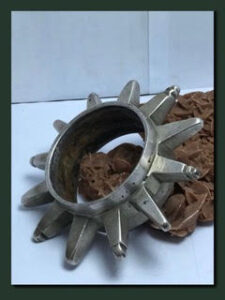
The Asbia Iquorain
The Asbia Iquorain or Biqaryune roughly translates to the one with horns. These cuffs from the Ait Atta tribe are another beautiful display of how Moroccans inspired themselves from the rays of the sun. Artisans created massive silver handcuffs weighing 500g to 800g, complemented by deadly spikes symbolizing the sun's rays. Artisans poured melted silver into molds to make these striking pieces. Ait Atta women consistently wielded these Asbia Iquorain to defend themselves during colonial raids, wars and tribal conflicts. These treasured cuffs were also a valuable piece that women passed down to their daughters and grand daughters as inheritance. This physical tradition guaranteed these women financial freedom and safety.
Ironically, during a time when European women could not vote or own their personal bank accounts, Moroccan women had control over the family’s wealth which usually was concentrated in the silver or gold a woman owned, making her a matriarch. Moroccan women were also heavily involved in tribal politics, as elders giving advice, as matriarchs electing leaders, and even making bridges between tribes by marrying their daughters off to potential tribal allies against western colonialism. These women safeguarded the Amazigh culture through orally transmitted stories, songs, and the meaning of many jewelry pieces.
The Hirz
The Hirz, a Talisman and Amulette was historically used to carry verses of the Quran. This was said to have protected the wearer from bad omens and the evil eye. Similar to beliefs in past civilizations, the Amazigh believed that people with bad intentions and energy can harm the soul. The Hirz, was also utilized sometimes to carry messages coded onto tiny pieces of paper usually containing verses. These messages often denounced the plans or positions of the enemy and were carried from place to place well hidden inside the women’s amulettes.
The Anbaria
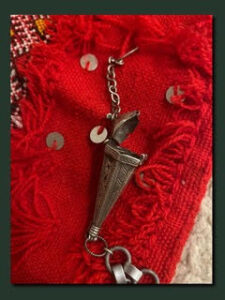
The Anbaria has historically been used to carry incense and ambergris, Amazigh women would wear it around their necks, attached to their headdresses, dangling from their waist chains, or belts throughout the day. These pure silver cone shaped containers would hold incense and fragrant plants that slowly released scents as temperatures fluctuated throughout the day. On the contrary, the Anbaria has also served to carry poison and gunpowder during colonialism. Women who were afraid of sexual violence especially coming from French and Spanish soldiers would carry poison extracted from plants such as the Atractylis gummifera (Addad), Euphorbia resinifera (Daghmous), Solanaceae Family Members (Henbane). Amazigh women have been known as renowned herbalists by way of cultivating and foraging plants to develop poisons and medicines.
The Taounza Or Talgamout
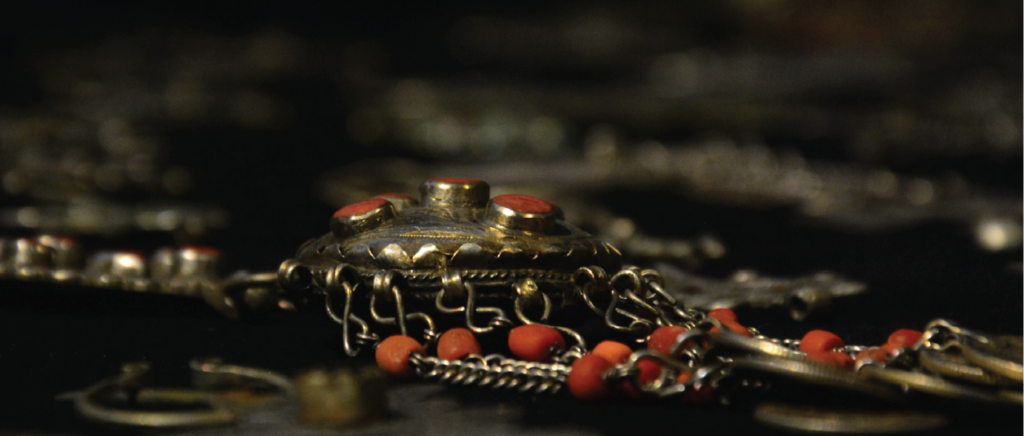
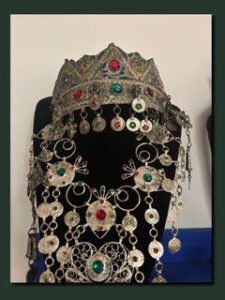
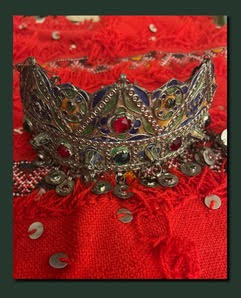
“Taounza” (translating roughly to ‘hair bangs’) or Talgamout (meaning ‘horse’s bit’), are headdresses often made with high-quality silver. They’re constructed with chains linking to a central ornate plaque or amulets embellished with dangling silver pieces, typically coins that would rest on the wearer’s forehead. Other ornaments of beauty sometimes included beads, shells, and coral pieces. Most Amazigh headdresses are adorned by silver coins, historically in times of duress, Amazigh women broke pieces off these headdresses and sold them or used them to buy necessities. These adornments served as a wearable wealth for women during a financial crisis.
Historically, Amazigh women were the main wearers of amber that came from the Baltic amber trade, Venetian beads from Venetian merchants, carnelian beads and gold from the Sahel, sea silk (Skalli), coral that came from Sicily and the Mediterranean, as well as ambergris and glass (cabochon) from other established trade routes. This all together demonstrates the importance of women in Amazigh culture, being draped and adorned by the finest materials is a privilege that reflects the high status of women in society.
Bibliography
Main image credits: Souhail Bouzaidi Cheikhi

Related resources