
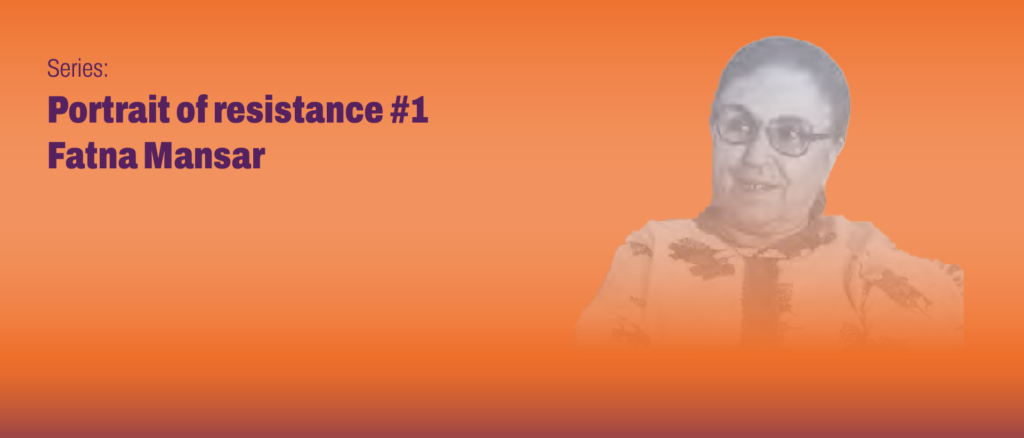

Portraits of Resistance – Fatna Mansar’s anti-colonial resistance
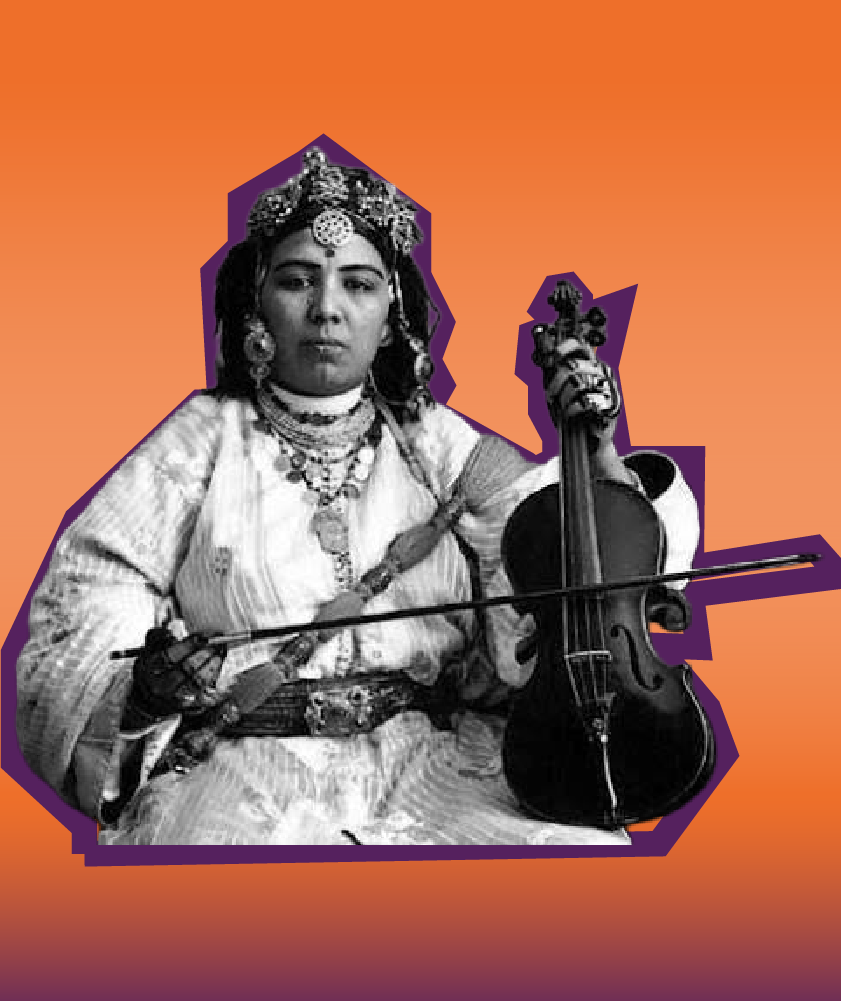
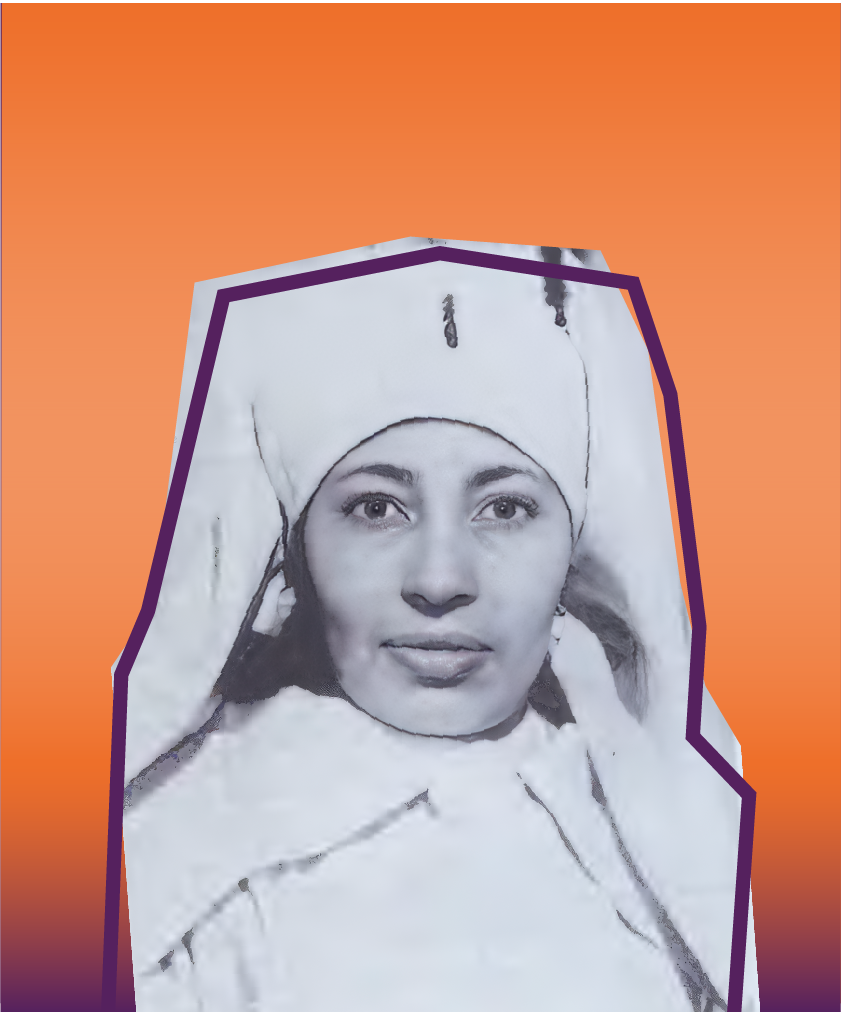
Fatna Mansar’s life begins in conditions of profound marginalisation, shaped by poverty, gendered constraint, and colonial domination. Born in 1931 into what she describes as “an extremely poor family, on the edge of penury” (Baker, 1998, p.171), her childhood was defined not by innocence but by deprivation and structural exclusion. Under the French Protectorate, inequality was not incidental but systemic: “those who were with the French… had everything they wanted; and those who were not were deprived of everything” (Baker, 1998, p.171), including access to education, which remained largely reserved for elite classes. In this context, Fatna’s early life exemplifies what Osire Glacier identifies as the exclusion of women, alongside other subaltern groups, from historical narratives traditionally centred on elites (Glacier, 2006, p.2).
This marginalisation was compounded by gendered confinement. Married at the age of ten, Fatna recalls being subsequently “locked… in the house” (Baker, 1998, p.171) because she was considered too young to participate in public life. Her experience reflects a broader normative horizon in which a woman’s life trajectory was tightly circumscribed: “a woman left the house of her father to go to her husband’s house… and to the cemetery” (Baker, 1998, p.169). Such formulations encapsulate a social order structured to contain women spatially, politically, and symbolically. As Fatima Mernissi argues, patriarchal power in North African contexts is frequently organised through the regulation of women’s mobility and access to public space (Mernissi, 1987). Fatna’s testimony illustrates this structure not as abstraction, but as lived confinement.
Yet Fatna’s narrative is marked by a rupture—an image that unsettles this enclosure. As a child, she encountered a newspaper photograph of Palestinian women armed and fighting. She recalls being transfixed: “I saw women carrying machine guns, climbing mountains… I just stayed there like this [amazed, mouth open]” (Baker, 1998, p.169). This visual encounter prompted a moment of critical reflection: “Why do they tell Moroccan women one thing, and there they tell women something different?” (Baker, 1998, p.169). The image operates here as a catalyst for political consciousness, revealing the contingency of gender norms. In her interpretation, these women appeared to transcend imposed limits: “she must be a woman and a man at the same time” (Baker, 1998, p.169). This moment echoes Lila Abu-Lughod’s critique of representations that portray women in the region as passive victims, instead showing how individual experiences can reveal that social norms are not fixed (Abu-Lughod, 2002).
The turning point of organised resistance came in the wake of the 1953 exile of Sultan Mohamed V, which catalysed anti-colonial mobilisation across Morocco. Like many resistance networks, these clandestine groups were male-dominated, and Fatna was initially denied responsibilities within them because she was a woman (Baker, 1998, p.173). Refusing this marginalisation, she asserts her agency with striking clarity: “I stepped forward and imposed myself” (Baker, 1998, p.173), warning that she would act independently if necessary. This act of self-authorisation challenges both colonial hierarchy and patriarchal control, marking her entry into active resistance.
Her early activities—organising aid for prisoners and their families—soon expanded into more dangerous operations. In 1954, she participated in an attempted arson attack targeting two grocery shops that had refused to observe a strike, marking her first direct act of resistance. Shortly thereafter, she was entrusted with transporting weapons, taking on a central logistical role within the network. She would later become the individual responsible for arms, a position requiring coordination, secrecy, and autonomy. Her testimony demonstrates how competence and risk could reconfigure gendered expectations within the movement, even if formal hierarchies remained intact. As Hasso (2005) demonstrates in her analysis of Palestinian political movements, women’s participation in such contexts often emerges through negotiated and non-formalised entry into male-dominated structures.
Central to Fatna’s account is the tactical use of gendered assumptions. Women’s perceived passivity enabled them to move with relative freedom under colonial surveillance. As she explains, weapons were concealed in everyday objects: she hid them in baskets beneath vegetables or carried them on her body, adapting her methods according to circumstance (Baker, 1998, p.174). In contrast to men, who were routinely searched, “most of the time they didn’t search women” (Baker, 1998, p.175). This asymmetry transformed gendered invisibility into a strategic asset, extending Osire Glacier’s argument by showing how the historiographical invisibility she identifies could also function tactically within colonial surveillance.
The risks involved were extreme. In one of her most striking recollections, Fatna describes being stopped by colonial authorities while unknowingly carrying weapons and resistance materials in her bag. Confronted with the possibility of arrest and torture, she prepares herself for silence: “When they begin to beat me… I won’t talk… I’ll just keep saying: ‘Allah…’ until I die” (Baker, 1998, p.174). This moment captures the embodied stakes of resistance—where political commitment is inseparable from the possibility of death.
Despite such contributions, the post-independence archive struggled to recognise women like Fatna as political actors in their own right. During the process of verifying resistance credentials, testimonies repeatedly cast doubt on her agency, suggesting that “she herself did not carry out any resistance operation” (Baker, 1998, p.178) or attributing her actions to male relatives. More broadly, there remained “the suspicion that she knew the details… because her husband had been involved” (Baker, 1998, p.178). These archival dynamics reveal how women’s participation was mediated, diminished, or erased, reinforcing their marginal status even within narratives of national liberation. As Nawal El Saadawi has argued in a different Arab context, women’s political contributions are often acknowledged only insofar as they remain attached to male authority rather than recognised as autonomous acts (El Saadawi, 1983).
Fatna’s later reflections extend this critique into the postcolonial present. She identifies persistent structural barriers to women’s equality, describing “an invisible hand that keeps women down” (Baker, 1998, p.181) and arguing that “men are afraid that women will get ahead of them” (Baker, 1998, p.181). Yet her analysis also insists on the interdependence of social transformation: “the man can’t move ahead in life without the woman; she is always at his side” (Baker, 1998, p.181). In this sense, her testimony reframes resistance not only as anti-colonial struggle but as an ongoing project of gender justice.
By narrating her own experience, Fatna Mansar disrupts archival silences. Her story challenges heroic, male-centred accounts of Moroccan independence by grounding political struggle in lived experience: poverty, confinement, risk, and moral resolve. As Fadma Aït Mous (2021) suggests, women’s roles in nationalist movements often appear as a ‘missing presence’ in archival and historiographical accounts, where they are rendered anonymous or symbolic rather than recognised as historical actors. Osire Glacier argues that feminist historiography seeks to reconstruct women’s participation in political life, demonstrating that struggles for gender equality are rooted in Moroccan and broader Arabo-Muslim historical contexts, rather than imposed from outside (Glacier, 2006, p.5). Through her testimony, Fatna asserts her place within that history—no longer invisible, but indispensable.
References
Abu-Lughod, L. (2002). Do Muslim women really need saving? Anthropological reflections on cultural relativism and its others. American Anthropologist, 104(3), 783–790.
Aït Mous, F. (2021). La place des femmes dans des textes nationalistes de la période coloniale: Une présence manquante [Women’s position in nationalist texts during the colonial period: A missing presence]. Hespéris-Tamuda, 56(1), 171–188.
Baker, A. (1998). Fatna Mansar: Casablanca. In Voices of resistance: Oral histories of Moroccan women (pp. 169–181). State University of New York Press.
El Saadawi, N. (1983). The hidden face of Eve: Women in the Arab world. Zed Books.
Glacier, O. (2006, March 20). Des Marocaines engagées [Engaged Moroccan women]. MarocAntan.
Hasso, F. S. (2005). Resistance, repression, and gender politics in occupied Palestine and Jordan. Syracuse University Press.
Mernissi, F. (1987). Beyond the veil: Male-female dynamics in a modern Muslim society (Rev. ed.). Indiana University Press.

Related resources