

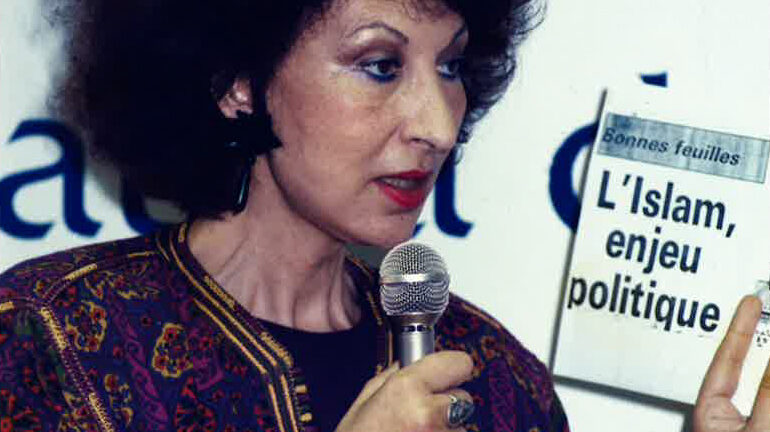

Beyond the Veil: Rereading Mernissi in the 21st Century
In her seminal 1975 work, Beyond the Veil: Male-Female Dynamics in a Modern Muslim Society, sociologist Fatima Mernissi presents a groundbreaking and critical analysis of gender relations and the construction of social space in a Muslim society, with a focus on Morocco. The book’s central, groundbreaking thesis is that the systemic subordination of women in many Muslim-majority societies is not an inherent or divinely ordained aspect of Islam, but rather a complex socio-political construct that serves a specific patriarchal order. Mernissi argues that this subordination is not a religious mandate, but a socio-political tool designed to control female sexuality and social organization. Her work fundamentally challenges the idea that women's seclusion and the ideology of the veil are purely religious prescriptions, instead analyzing them as components of a system of power and spatial control.
At the heart of Mernissi’s analysis is the concept of "sexual geography." She posits that a "Muslim theory of female sexuality" has traditionally viewed female sexuality (fitna, or fitnah) as a potent, dangerous, and disruptive force that can threaten the social and cosmic order. To manage this perceived danger, a strict spatial division is enforced. This ideology creates a fundamental divide between a male public space (the ummah) and a female private domain (the harem). In this framework, the architecture of the traditional home and the practice of veiling (hijab) are not merely religious symbols but crucial instruments for controlling this spatial and social order. The veil, in this context, is analyzed not as a simple piece of cloth but as a "mobile screen" or a portable boundary. It allows women to briefly enter the male-dominated public sphere—the domain of the souk, the mosque, and political power—while still containing the "danger" of their presence and maintaining the symbolic spatial boundary between genders. The home, or the harem, is thus not just a private space but a socially sanctioned spatial and symbolic system designed for the control of female sexuality and the preservation of a patriarchal social structure.
Mernissi’s radical re-examination of the "harem" further deconstructs the Western myth of the harem as a site of hedonism. She reconceptualizes it as a complex political institution and a center of power. Within the private, women-only space of the harem, she argues, women could wield significant social and political influence, strategize, and form powerful matriarchal networks. This challenges the passive, orientalist image of secluded women, replacing it with a view of the harem as a space where power dynamics and influence operated through channels distinct from the male public sphere. However, Mernissi's core argument is that this system, while offering a form of female-centered power, existed within and was designed to maintain the larger patriarchal order. It was a system of control that also, paradoxically, created a space for female agency within its strict confines.
The book further argues that the subjugation of women is often justified by a selective, patriarchal interpretation of Islamic texts and tradition (Hadith). Mernissi famously argues for a hermeneutical approach, advocating for a return to the original, more egalitarian spirit of Quranic principles, which she and other feminist scholars argue was later interpreted and codified in ways that entrenched male authority. In the final section, Mernissi examines the modern era, where she observes a complex relationship with tradition. She notes a paradox: as women gain legal rights and education, and as they enter the modern, mixed-gender workplace and public sphere, a symbol like the veil can be reinterpreted. The "return" of the veil, from this sociological perspective, is not a simple step backwards. For some modern women, she suggests, it can become a complex symbol—a "mobile shelter" that paradoxically allows a woman to claim a visible Muslim identity and a traditional form of modesty while navigating a newly integrated, modern, and public world. In essence, Mernissi's work dissects the architecture of gender, power, and space, arguing that the veiling and seclusion of women are not timeless religious edicts but powerful tools in a socio-political system, the foundations and consequences of which she masterfully deconstructs.

Related resources
A Cinematic Mosaic: Arab and North African Women’s Voices on Screen
13/02/2026